Performance improvement plan template
A performance improvement plan is not a warning with a deadline attached.
It is a written agreement about what good looks like, what support the employee gets, and how both of you will know whether it worked.
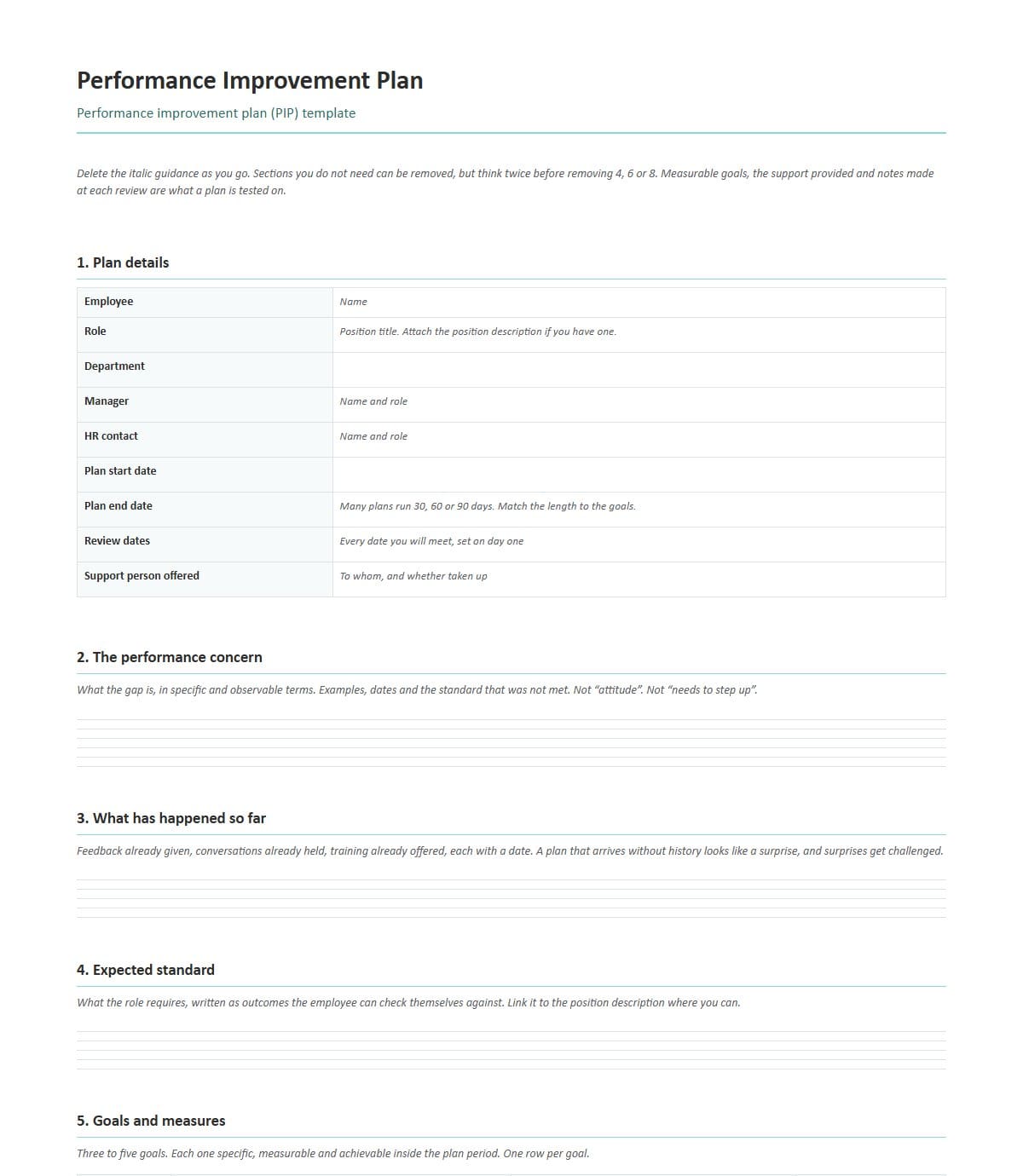
This performance improvement plan (PIP) template is the structure that works, free to download and use as it is or adapt to your own process.
Underneath it: how to write a strong performance improvement plan, how to run it, and the three things that make one fall over.
Download the PIP template
The free performance improvement plan template as a Word document. 10 sections, completely free to use, no sign-up needed.
Plan details · performance concern · history · expected standard · goals and measures · support · review schedule · progress notes · outcomes · acknowledgement
Page one of the performance improvement plan template. Ten sections, Word format, free to download and adapt.
What is a performance improvement plan?
A performance improvement plan is a formal improvement plan for an employee whose work is not meeting the standard of the role. It names the performance gap, sets measurable objectives for closing it, lists the support the employee will get, and fixes the dates progress will be reviewed.
Done well, it gives both the employee and the manager a shared understanding of what has to change and by when. Done badly, it is a box ticked on the way to a decision that was already made, and employees can tell the difference.
A PIP template keeps every plan in the same shape, with the same key elements. The same sections, in the same order, whichever manager writes it and whichever team it is for.
When to use a performance improvement plan, and when not to
A performance improvement plan (PIP) is for performance issues: employee performance itself is below the expected standard. Missed deadlines, quality problems, targets not met, skills that have not kept pace with the role.
It is usually the wrong tool for:
- Conduct issues. Misconduct is handled under your disciplinary or investigation process, not by setting goals.
- A first conversation. If nobody has raised the concern informally yet, start with direct feedback. A plan that arrives without warning is the first thing anyone questions later.
- Something outside work. Health, caring responsibilities or another personal matter may need support or adjustments first. Take advice if you are unsure.
If the performance concerns are real, specific and have already been raised, a performance improvement plan is a fair way of addressing employee performance concerns. It gives the employee a fair opportunity to improve, and gives HR teams a clear record of that opportunity.
Common performance issues a PIP can address
Most performance improvement plans deal with one of a handful of employee performance issues. Identify specific performance issues before you write anything, because the goals follow from them.
- Missed deadlines. Work delivered late, or without warning that it would be.
- Quality. Errors, rework, or work that does not meet the quality standards and quality expectations of the role.
- Productivity. Output consistently below what the role and the team expect, or not meeting expectations set in earlier performance reviews.
- Skills. A skill the role now needs, such as a system, a process or communication skills, that has not been learned.
- Time management. Priorities slipping, meetings missed, work started late.
If the concern is behaviour rather than the work itself, check whether it belongs in a different process before you use a PIP.
What goes in each section of the performance improvement plan template
1. Plan details
Employee, role, manager, department, HR contact, start date and review dates. The header that tells you, months later, who agreed to what and when.
2. The performance concern
What the gap is, in specific and observable terms. Examples, dates and the standard that was not met. Not “attitude”. Not “needs to step up”.
3. What has happened so far
Feedback already given, conversations already held, training already offered. A plan that arrives without history looks like a surprise, and surprises get challenged.
4. Expected standard
What the role requires, written as outcomes the employee can check themselves against. Link it to the position description where you can.
5. Goals and measures
Three to five improvement goals. Each one specific, measurable and achievable inside the plan period. For each: the success metrics, how progress will be measured, and what counts as met.
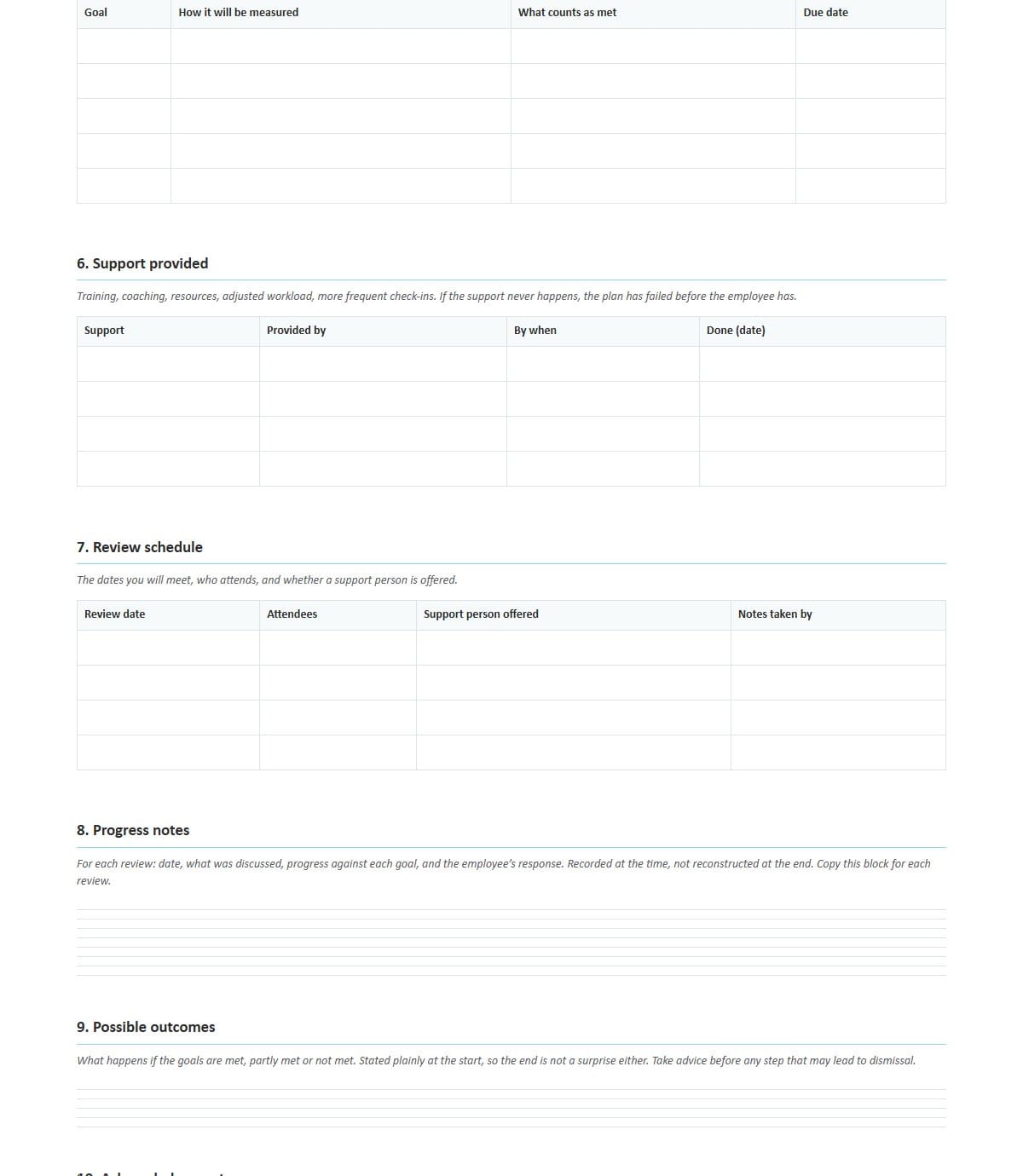
6. Support provided
Training course, coaching, support resources, adjusted workload, more frequent check-ins. Who provides each, and by when.
7. Review schedule
The dates you will meet, who attends, and whether a support person is offered. Regular check-ins are how you review progress, so put them in the calendar on day one.
8. Progress notes
For each review: date, what was discussed, progress against each goal, and the employee’s response. This is your progress tracking: recorded at the time, not reconstructed at the end.
9. Possible outcomes
The PIP outcomes: what happens if the goals are met, partly met or not met. Stated plainly at the start, so the end is not a surprise either.
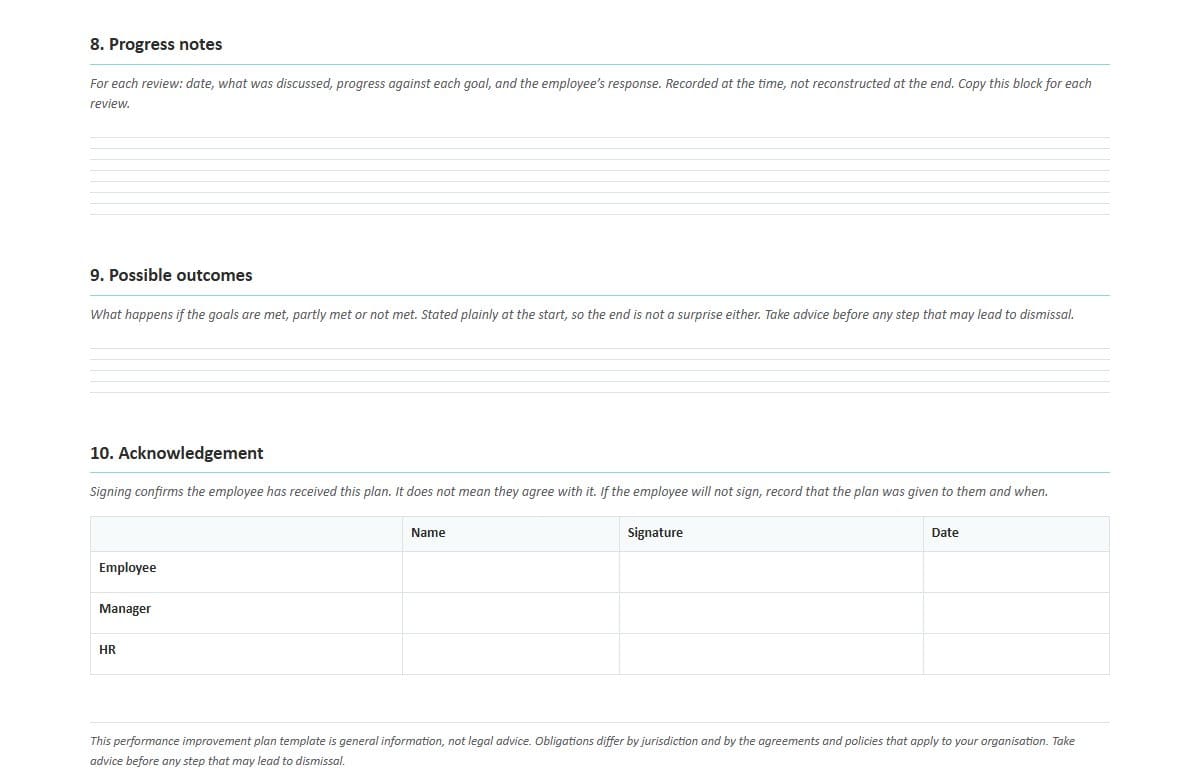
10. Acknowledgement
Signatures from the employee, manager and HR. Signing confirms the employee received the plan, not that they agree with it. Say so on the form.
Got the structure? Download it.
The same ten sections as a Word document you can fill in and adapt.
Plan details · performance concern · history · expected standard · goals and measures · support · review schedule · progress notes · outcomes · acknowledgement
How to write a performance improvement plan
Most of the work happens in the performance conversations before anyone opens the performance improvement plan template.
- Name the gap with specific examples. Three concrete examples with dates beat a page of adjectives. Say what was expected and what happened instead.
- Write measurable goals. Each goal needs a measure and a date, so you get measurable targets rather than impressions. “Deliver weekly client reports by 5pm Friday, with no more than one correction” can be met or missed. “Be more reliable” cannot.
- Agree the support. Training, coaching, closer supervision, a lighter workload for the improvement period. Write down who provides each and when.
- Set the check-in schedule. Regular check-ins, usually weekly or fortnightly, with a final review at the end. Put every date in the plan.
- State the possible outcomes. What happens if the goals are met, partly met or not met. Clear expectations at the start avoid a dispute at the end.
Then hold the initial meeting, walk the employee through the plan, and record their response.
Performance improvement plan example
A performance improvement plan example: one goal, written the way the template asks for it, with measurable outcomes. The employee is a project coordinator who has missed project deadlines on three client projects in the last quarter.
- Performance concern: three project deadlines missed in the last quarter (dates and projects listed), each without notice to the project lead.
- Goal: meet every project deadline for the next 60 days, or flag a risk to the project lead at least two working days before the deadline.
- How it will be measured: the project tracker, reviewed at each check-in.
- What counts as met: no missed deadline without two working days’ notice.
- Support: an action plan with a time management course in week one, and a 15-minute weekly planning session with the project lead.
- Check-ins: every second Friday, with a final review on day 60.
One goal like this is clearer than five vague ones. Most plans need three to five.
30, 60 or 90 days: choosing the PIP period
The PIP period is the time the employee has to demonstrate improvement. Most plans run 30, 60 or 90 days.
- 30 days suits a narrow, easily measured gap, such as a deadline or a single process.
- 60 days suits most plans: long enough to see a pattern, short enough to stay a priority.
- 90 days suits goals that need training first, or work that runs in longer cycles.
Whatever the length, the improvement period should be long enough to show sustained improvement, not one good week. Set it in the plan, and only extend it if the employee is making real progress.
How to run a performance improvement plan from start to finish
- Check it is the right tool. Is this a capability gap, a conduct issue, or something outside work? A conduct issue may need a different process.
- Prepare the evidence. Examples, dates, the standard, and the feedback already given.
- Meet and agree the plan. Explain the concern, the goals, the support and the timeline. Offer a support person. Record the employee’s response.
- Provide the support you promised. If the training never happens, the plan has failed before the employee has.
- Review on the dates you set. Record progress against each goal, every time.
- Close it out. Met, extended, or the next step in your process. Tell the employee in writing.
How to track progress during the PIP period
A plan is only as good as the record of what happened during it.
At each check-in, monitor progress against every goal, not just the ones that went badly, and write it down. That record is how you track progress, and how you show the improvement, or the lack of it, later. Note the support that was provided, and anything that was promised and did not happen. Record the employee’s response in their own words.
Keep the notes with the plan, and keep the plan with the feedback that came before it. When someone asks how the decision was reached, or whether the performance improvement plan works, the answer should be one file, in date order.
Tips for managers running a performance improvement plan
The manager runs the plan day to day and HR supports it. Both the manager and HR should be clear on their part before the initial meeting.
- Clarify expectations at the start. Go through each goal until the employee can say what success looks like in their own words.
- Provide ongoing feedback between check-ins. Ongoing feedback means the final review is never the first time the employee hears how it is going.
- Deal with emerging challenges early. If the support runs late or the work changes, adjust the plan in writing and note why.
- Keep it separate from performance reviews. A PIP addresses one specific gap. The annual review covers the whole role.
- Want the employee to succeed. The improvement process works best when the manager wants the plan to work, and employees understand that it is a real chance.
For managers with several direct reports, using the same PIP template every time keeps plans consistent and fair, and makes them part of employee development rather than only risk management.
Three things that make a performance improvement plan fall over
The goals were vague.
“Improve communication” cannot be measured, so it cannot be met or missed. The plan ends in an argument about what was meant.
The support was promised and not delivered.
The coaching sessions were cancelled, the training was never booked. When the outcome is challenged, that is the first thing anyone asks about.
The record is in five places.
Feedback in emails, the plan in a Word folder, meeting notes in a calendar, warnings drafted separately. When the process becomes serious, nobody can show the full history in order.
A template is a starting point, not a system
A template gives the plan a shape. It does not remind anyone that a review is due, show the feedback that came before it, or link it to the warning that may follow.
Dazychain HR helps HR teams manage performance concerns, coaching, feedback, performance improvement plans, warnings, documents, meetings, decisions and termination support in structured workflows.
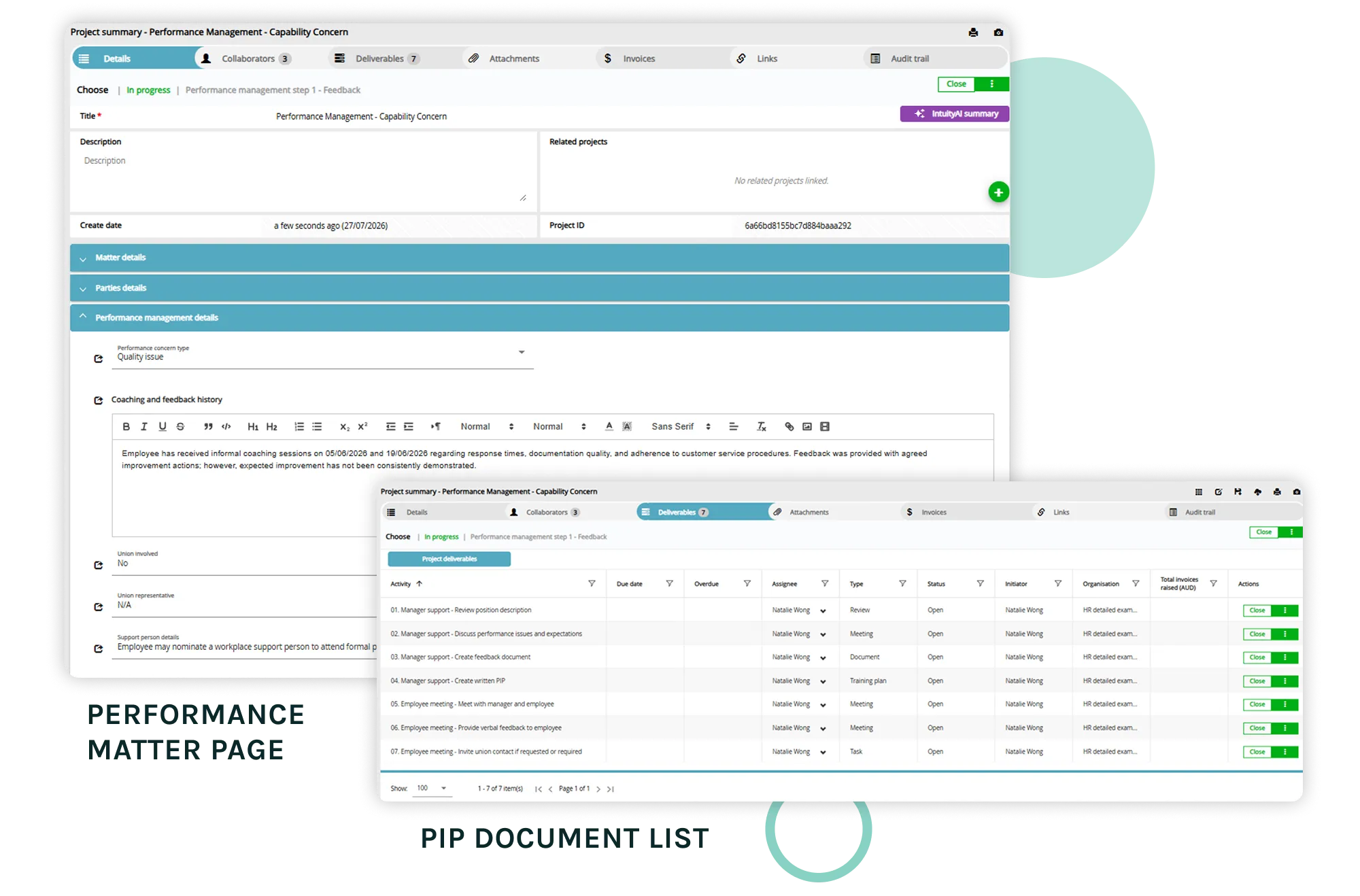
Built for performance matters people will challenge
Role based access
Performance detail is visible only to the people who need it.
A full audit trail
Every action on a matter is recorded, with who did what and when.
Encrypted end to end
AES-256 encryption at rest and TLS 1.3 in transit.
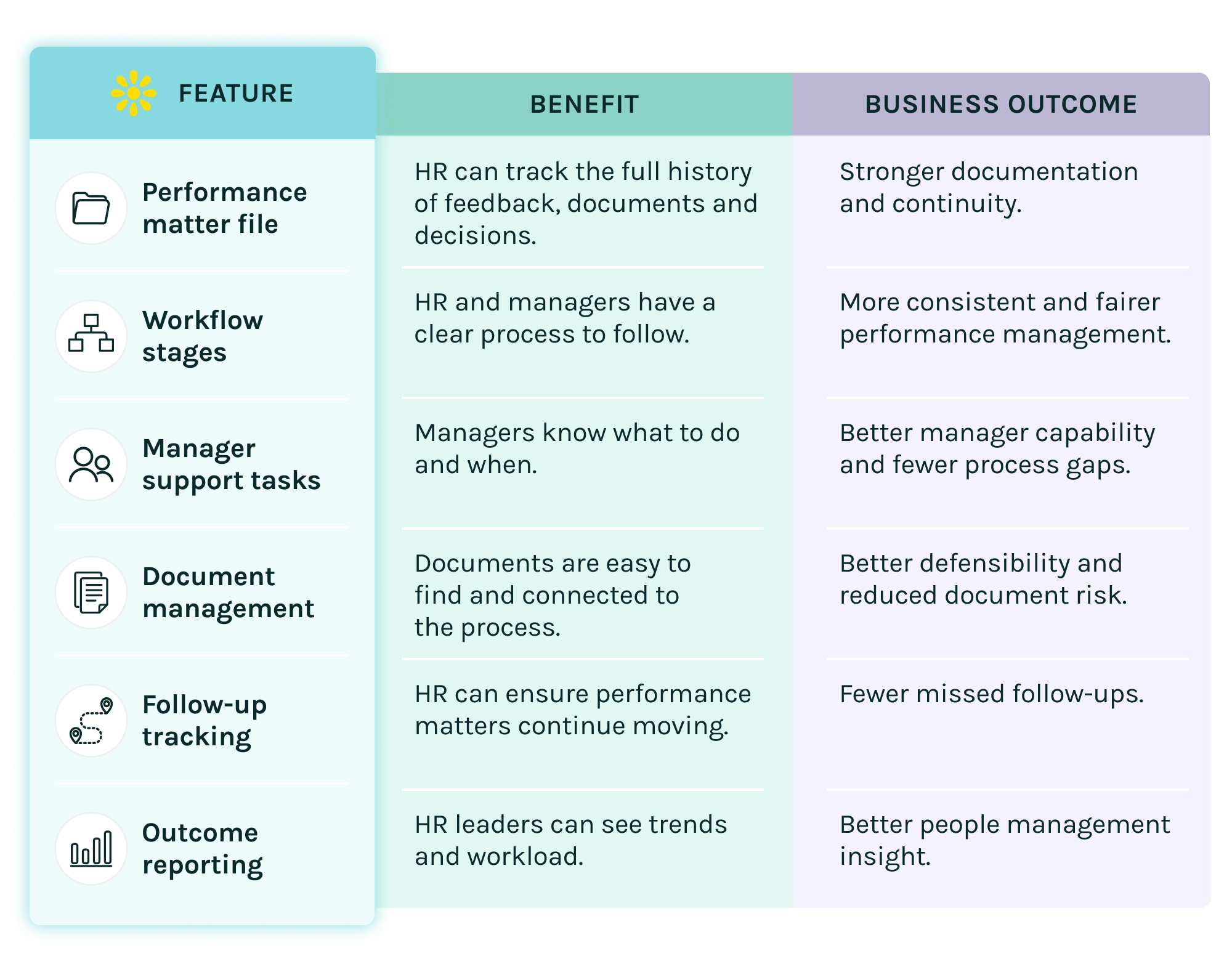
Questions we get asked about performance improvement plans
What should a performance improvement plan include?
The key elements are the performance concern with specific examples, the expected standard, measurable goals, the support provided, a review schedule, progress notes, the possible outcomes and an acknowledgement. The template on this page has a section for each.
Is a PIP a trap?
It should not be. A plan with measurable goals, real support and honest check-ins gives the employee a genuine chance to improve, and many do. If the outcome has already been decided, the plan is not a performance improvement plan, and it will not hold up if it is challenged.
How long should a performance improvement plan last?
Long enough for the employee to show the change, and short enough that it stays a priority. Many plans run 30, 60 or 90 days. Match the length to the goals, not the other way round.
Does the employee have to sign it?
Ask them to sign to confirm they received it. If they will not sign, record that you gave it to them and when. A signature is not agreement, and the form should say so.
Is a performance improvement plan the same as a warning?
No. A warning records that a standard was not met. A plan sets out how to meet it, with support and a timeline. Many processes use both, in a set order. Check yours.
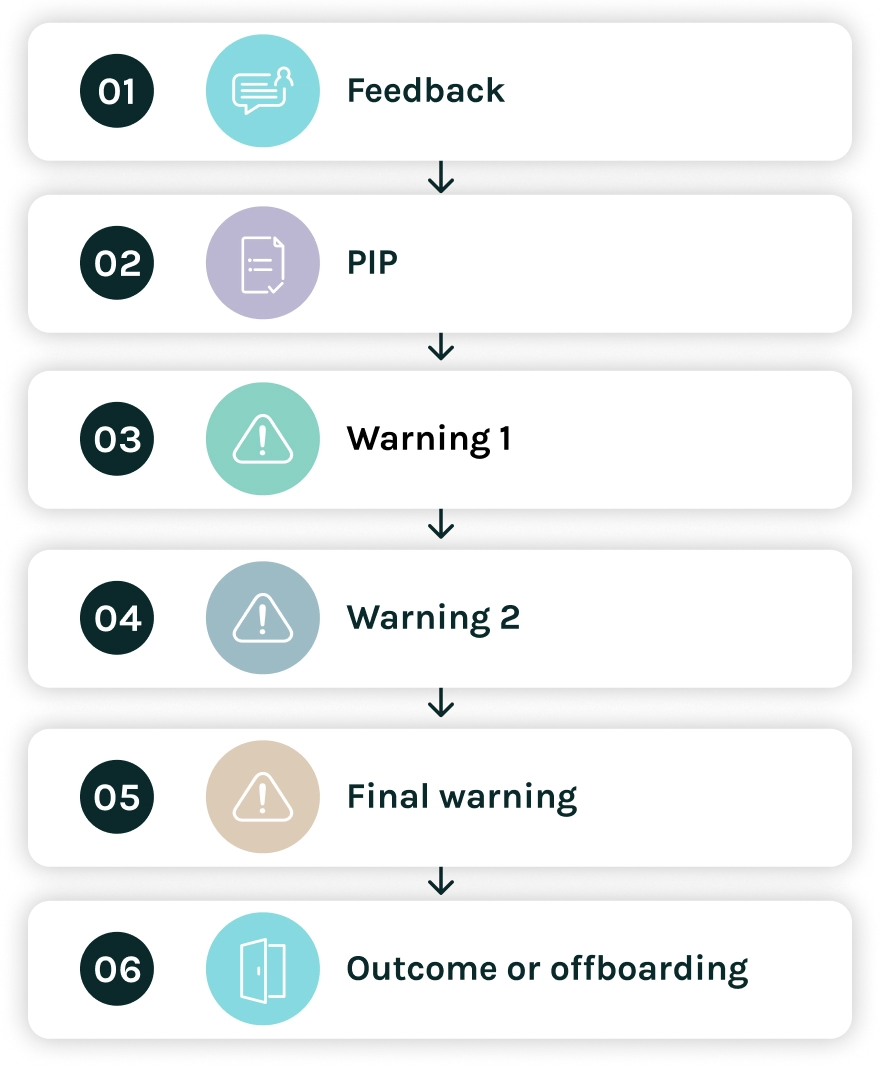
What happens at the end of the plan?
One of three things: the goals are met and the plan closes, progress is real but incomplete and the plan is extended, or the goals are not met and you move to the next step in your process. Take advice, or get a legal review, before that final outcome, as it depends on your jurisdiction and your policies.
Run your next performance improvement plan in one secure place
Documentation, meetings, warnings and outcomes are captured in one matter record. Tasks and review dates help prevent drift.