Employee write up form template
A write-up is not a punishment. It is the record.
It shows what happened, what was said, what has to change, and what happens if it does not.
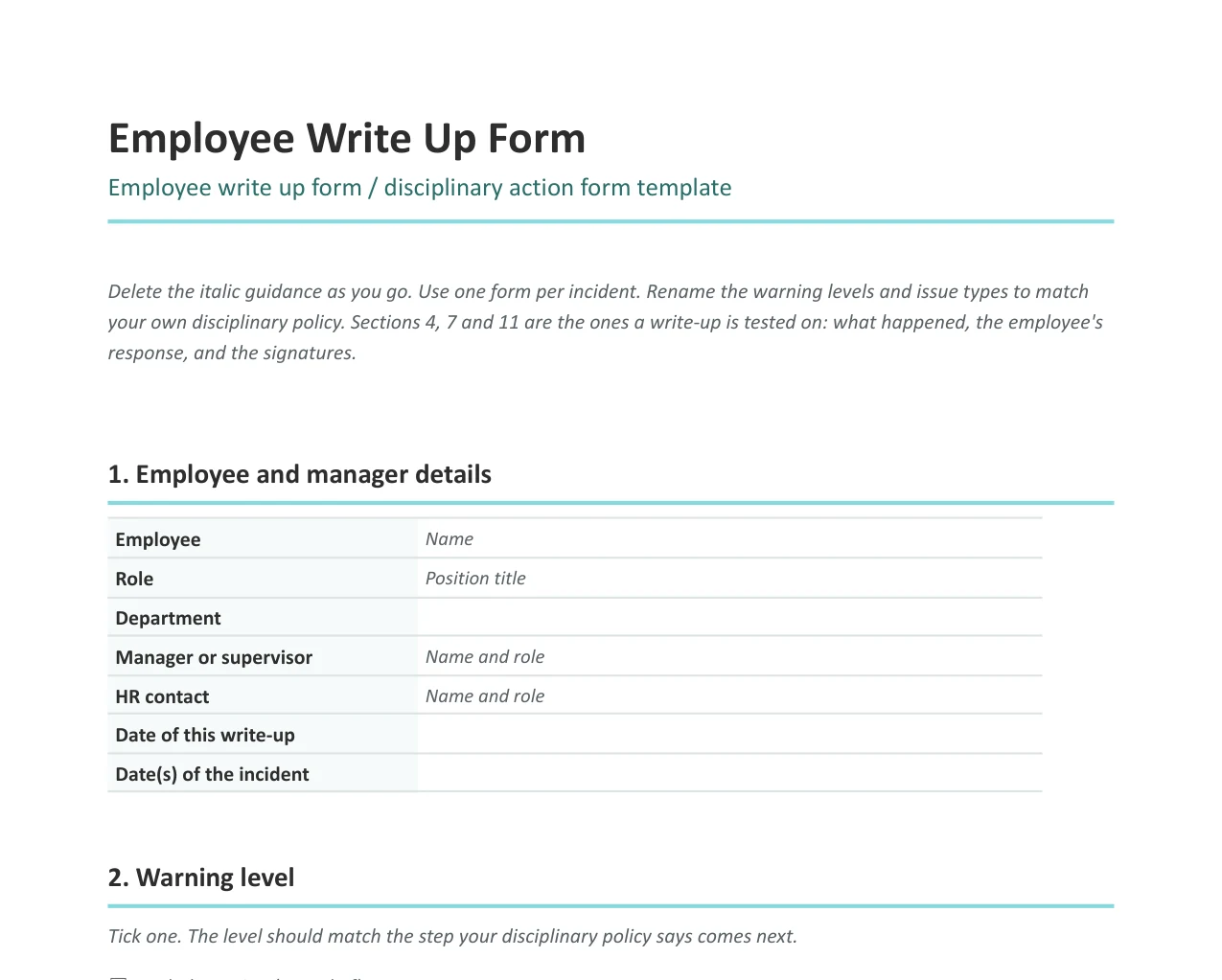
This employee write-up form gives every warning the same structure. It works as a disciplinary action form, a written warning template or an employee warning notice. Download the form template free, use it as it is, or adapt it to your own disciplinary process.
Underneath it: when to use a write-up, how to write up an employee, the difference between verbal, written and final warnings, and the three things that make a write-up fall over.
Download the employee write up form
The free employee write up form template as a Word document. 11 sections, completely free to use, no sign-up needed.
Employee details · warning level · type of issue · what happened · supporting documentation · previous warnings · employee response · corrective action · consequences · review date · signatures
Page one of the employee write up form template.
What is an employee write up form?
An employee write up form is the document a manager, supervisor or HR uses to record a disciplinary action. It sets out the employee conduct or performance issue in the workplace, the company policies it breaches, the corrective action expected, and what happens if it continues.
Most organisations call it one of three things: a write-up, a disciplinary action form, or a written warning. They are the same document. An employee disciplinary action form is simply the more formal name.
A standardised form matters more than it sounds. When every manager and supervisor uses the same employee disciplinary action form, similar issues get recorded the same way, and the record makes sense to anyone who reads it later. Proper documentation, written at the time of each incident, is what gives you accurate records if a disciplinary action is ever reviewed.
How to use this disciplinary action form template
- Download the employee write up form. It is a Word document, so you can edit every field.
- Match it to your policy. Rename the warning levels and issue types to the ones your disciplinary policy uses, and add your logo.
- Use one form per incident. Fill it in at the meeting, attach the evidence, collect the signatures, and keep the signed copy on file.
The form template works for employers of any size, in any country. The details of your process, such as notice, appeal rights and how long warnings stay active, depend on your policy and local law.
When to use a disciplinary action form
Use a write-up when informal coaching has not fixed the problem, or when a first issue is serious enough to need formal disciplinary action straight away. Common examples:
- Attendance. Repeated tardiness, unexplained absences or leaving early without approval.
- Conduct. Inappropriate behaviour towards colleagues or customers, or breaking a code of conduct.
- Safety violations. Ignoring safety procedures or protective equipment rules.
- Policy breaches. Misuse of company systems, confidentiality breaches or breaking company policies.
- Performance. A missed standard the employee has already been coached on.
Two cautions. A disciplinary action form must never be used to retaliate against an employee for raising a complaint, taking protected leave or any other legally protected activity. And if the facts are disputed, investigate first and write up second.
What goes in each section of the employee write up form
1. Employee and manager details
Employee name, role, department, manager, HR contact and the date of the write-up. The header that tells you, months later, who was involved and when.
2. Warning level
Verbal warning (record of), first written warning or final written warning. Tick one. The level should match the step your disciplinary policy says comes next.
3. Type of issue
Attendance, conduct, performance, policy breach, safety, or other. Name the policy or standard that applies.
4. What happened
Describe the incident. Dates, times and what was seen or reported, in specific and observable terms. “Arrived 40 minutes late on 3, 7 and 12 March”, not “unreliable”. List the involved parties and any witnesses.
5. Supporting documentation
Attach what backs up the description: time records, emails, incident reports, witness statements. Note on the form what is attached, so the record is complete for future reference.
6. Previous discussions and warnings
Earlier conversations, coaching and warnings about the same issue, with dates. A write-up that arrives without history looks like a surprise.
7. Employee’s response
The employee’s account, in their words. Leave real space for it, and record it even if they decline to comment.
8. Corrective action and support
The corrective action expected: what has to change, by when, and the support the employee will get, such as training, coaching, a changed roster or more frequent check-ins.
9. Consequences if it happens again
The next step in your process if the issue continues. Stated plainly now, so it is not a surprise later.
10. Review date
When you will meet again to check progress. Put it in the calendar on the day.
11. Signatures
Employee, manager and HR, with dates. When the employee signs, it confirms acknowledgment that they received the write-up, not that they agree with it. The form says so. If the employee will not sign, the manager records that, with a witness where your policy asks for one.
Got the structure? Download it.
The same eleven sections as a Word document you can fill in and adapt.
Employee details · warning level · type of issue · what happened · supporting documentation · previous warnings · employee response · corrective action · consequences · review date · signatures
How to write up an employee
- Check the facts and the policy. What happened, when, and which standard it breaks. If you cannot point to the standard, stop here. Document incidents as they happen, not weeks later.
- Check the history. Earlier conversations and warnings decide which warning level this is.
- Meet privately. Explain the concern and show the evidence. Offer a support person if your policy allows one.
- Let the employee respond. Listen, and record their account on the form.
- Agree what has to change. Improvement, support and a review date.
- Sign, copy and file it. The employee gets a copy. The original goes in the employee’s personnel file, stored securely where only the people who need it can see it.
- Follow up on the review date. A write-up nobody follows up is a write-up that did not happen.
Verbal, written and final warnings: what is the difference?
Verbal warning. A conversation about a minor or first issue. It is still worth recording that it happened, when, and what was said. The verbal warning nobody wrote down is the one you will need later.
Written warning. A formal employee warning notice for a repeated issue, or a more serious first one. It sets out what happened, what has to change and what happens next.
Final written warning. The last step before a more serious outcome such as dismissal. It should say exactly that.
Many disciplinary processes use these steps in order, an approach called progressive discipline. Our guide to progressive discipline covers the steps, when you can skip them, and what changes between Australia and the United States.
Three things that make a write-up fall over
The description is vague. “Poor attitude” cannot be checked, so it cannot be fixed or proven. Write what happened, when, and what the standard was.
The employee’s side is missing. A disciplinary action form with no response recorded looks one-sided when it is read later.
Similar issues get different treatment. One manager gives a verbal warning, another a final written warning, for the same thing. Inconsistency is the first thing anyone looks for when a disciplinary action is challenged, and consistent treatment is your best protection against a claim that someone was singled out.
When a write-up is not the right tool
The issue is capability, not conduct. If someone is trying and falling short, a performance improvement plan template sets goals and support instead of a warning.
The allegation is serious or disputed. Harassment, bullying, fraud or anything where the facts are contested needs an investigation first. Our workplace investigation report template gives that the right structure.
The employee has raised a grievance. If they have made a complaint of their own, deal with it through your workplace complaints process rather than folding it into the write-up.
A form is a starting point, not a system
A form records one warning. It does not show the warnings that came before it, remind anyone that a review is due, or link it to the plan or outcome that follows.
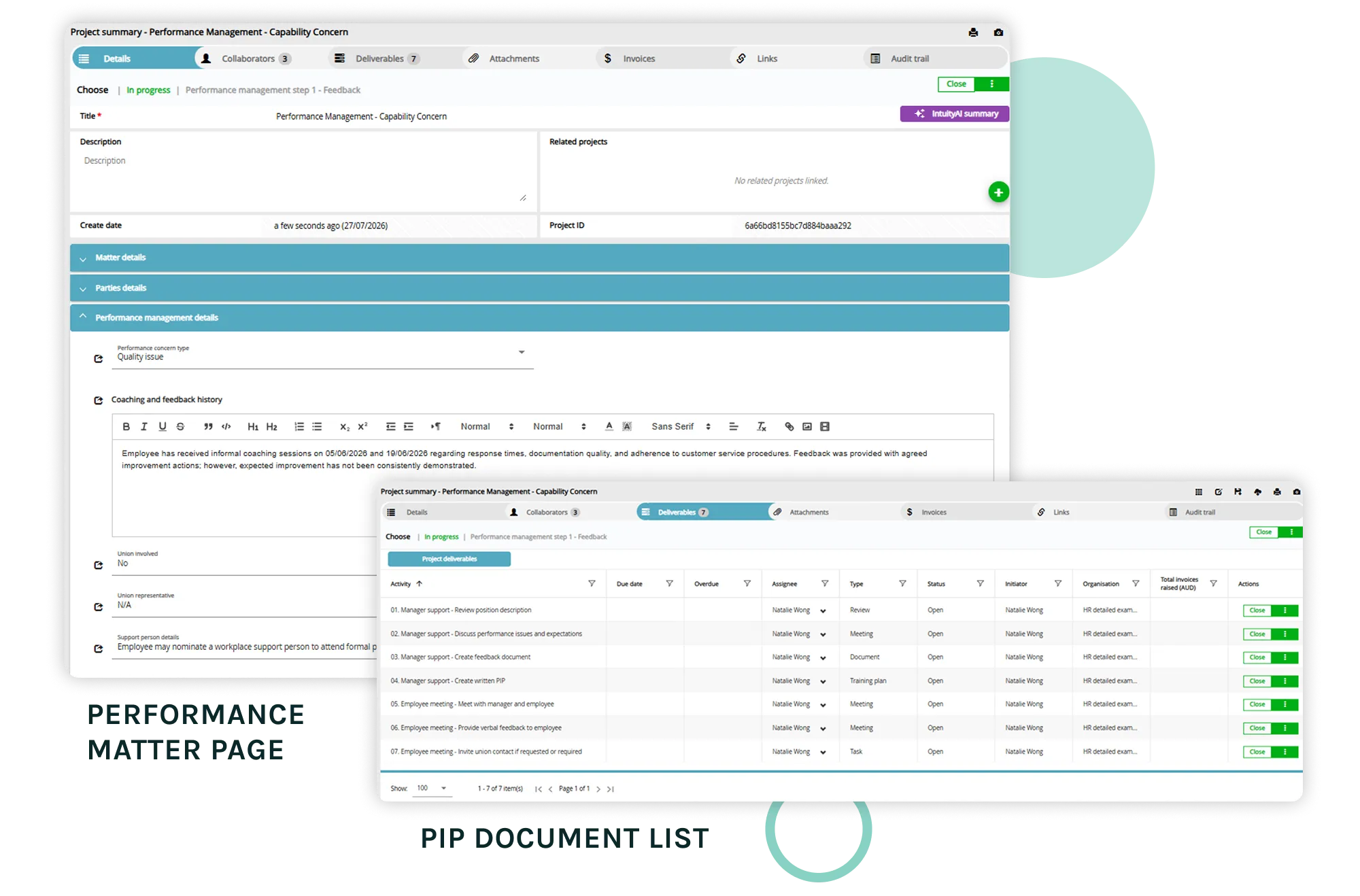
Dazychain HR helps HR teams manage feedback, coaching, performance improvement plans, warning letters, manager support, meeting notes, follow-up actions, disciplinary processes, termination support and reporting in one secure HR case management platform.
Documentation, meetings, warnings and outcomes are captured in one matter record, so record keeping is consistent and sensitive information is not scattered across inboxes and shared drives.
Role based access
Disciplinary detail is visible only to the people who need it.
A full audit trail
Every action on a matter is recorded, with who did what and when.
Encrypted end to end
AES-256 encryption at rest and TLS 1.3 in transit.
Questions we get asked about employee write up forms
Does the employee have to sign the write-up?
Ask them to sign to confirm they received it. If they will not, record that you gave it to them and when, with a witness if your policy asks for one. A signature is not agreement, and the form should say so.
Is a write-up the same as a written warning?
Usually, yes. “Write-up” is the everyday name for a written warning or disciplinary action form. Some organisations also use it for the record of a verbal warning. Your policy should say which.
Can an employee refuse to sign a write-up?
Yes. Refusing to sign does not cancel the warning. Note the refusal on the form, date it, and give the employee a copy anyway.
How long does a write-up stay on an employee’s file?
It depends on your policy and your jurisdiction. Many policies say a warning stays active for a set period, often 6 to 12 months, while the record itself is kept longer. Check your own policy, and take advice if you are unsure.
Who should be in the room?
The employee, their manager, and usually someone from HR. Offer the employee a support person if your policy or local rules allow one.
Can I write up an employee for attendance?
Yes, if there is a clear attendance standard and the employee knew about it. Check first whether leave, illness or caring responsibilities are involved, as different rules may apply.
What is the difference between a write-up and a disciplinary action form?
There usually is none. A disciplinary action form is the formal name for a write-up. Some organisations keep a separate employee disciplinary action form for final warnings, suspensions or dismissal, so check which your policy uses.
How long does it take to fill in?
The form itself takes 10 to 15 minutes. The meeting, the employee’s response and the evidence take longer, and that is the part that makes the write-up stand up later.
Keep every warning in one secure record
See how Dazychain HR helps HR teams manage warning letters, meeting notes, follow-up actions and disciplinary processes in one secure HR case management platform.