Workplace investigation report template
A workplace investigation report is the document that has to hold up months later, when nobody remembers the detail and someone is questioning the decision.
This investigation report template is the structure that works, free to download and use.
Underneath it: how to run the investigation that fills it in, and the three things that make a report fall over.
Download the template
The HR investigation report template as a Word document. 12 sections, completely free to use, no sign-up needed.
Matter details · executive summary · allegations · policies applied · scope and terms of reference · process · evidence · interviews · findings · reasoning and credibility · conclusions and recommendations · outcome and action plan · exhibit list
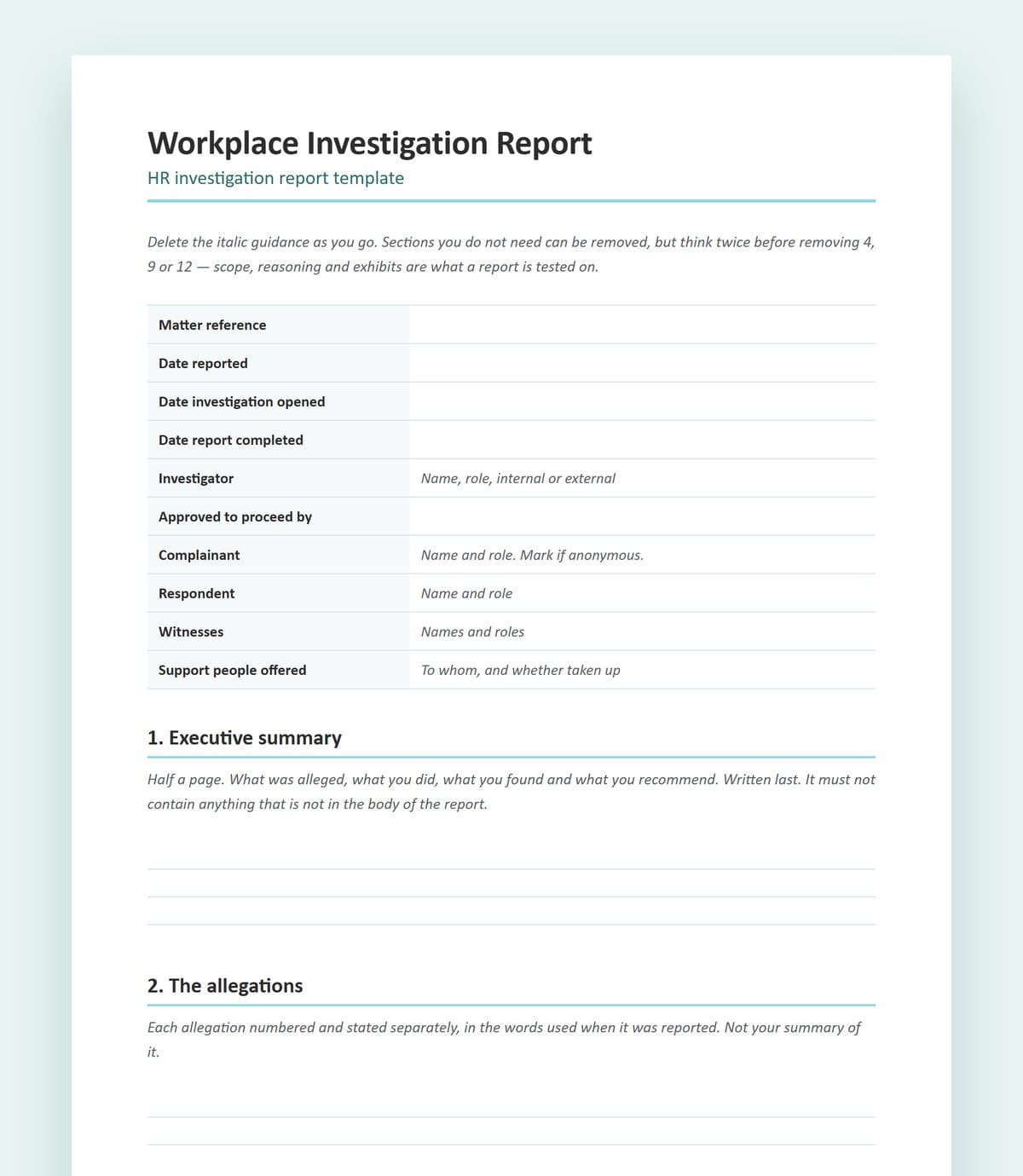
What goes in each section of the HR investigation template
1. Executive summary
Half a page. What was alleged, what the investigation did, what it found and what the report recommends. Written last. It must not contain anything that is not in the body of the report.
2. The allegations
Each allegation numbered and stated separately, in the words used when it was reported. Five allegations means five numbered entries here and five findings later.
3. Policies and standards applied
Which policy, code, agreement or legal standard the conduct in the investigation is measured against, and the version in force at the time. Attach the relevant extract as an exhibit.
4. Scope and terms of reference
What the investigation was asked to establish, and what it was expressly not asked to establish. Written before the first interview. If the scope changes, add a new dated line rather than editing the original.
5. Process followed
Each step of the investigation with a date: who you contacted, in what order, what each person was told about confidentiality, what support was offered, and any period where the matter paused and why.
6. Evidence
Every document, message, roster, access log and system record the investigation relied on, with its source and the date you obtained it. Record what you asked for and did not receive, and why.
7. Interviews
For each person: date, who was present, whether a support person was offered and taken, and the account given. Keep the account separate from your assessment of it.
8. Findings
Each allegation, one at a time. Substantiated, not substantiated, or unable to be determined, on the balance of probabilities.
9. Reasoning and credibility
Why you reached each finding. Which evidence you preferred and why, where accounts conflicted, and how you resolved it. Where credibility mattered, say what it turned on, and not on demeanour alone. This is the section that gets read when a decision is challenged, and the one most often left thin.
10. Conclusions and recommendations
What follows from the findings, and what you recommend. Separate from the decision: the investigator recommends, the decision-maker decides. Include the recommendations that are not about an individual, such as process, training and workload.
11. Outcomes and action plan
The outcomes of the investigation: the decision taken, by whom and when, then each action with an owner and a due date. Include how and when both parties were told.
12. Exhibit list
Numbered index of every document attached to the HR investigation report, matching the evidence references in section 6.
Why use an investigation report template at all?
An HR investigation report template gives every investigation the same shape, so anyone reading it can find the scope, the evidence and the reasoning in the same place each time.
It saves the investigator from rebuilding the structure for every case of employee misconduct, and it prevents the obvious omissions: the policy that was never named, the allegation nobody formally answered, the exhibit list nobody compiled.
It also helps with legal requirements.
Most of what makes an investigation report defensible is documentation discipline rather than legal drafting, and a template enforces the discipline whether the matter is a single complaint or a long-running investigation process.
Adapt the template to your own process. Delete the sections you don’t use.
The three sections worth keeping whatever else goes are the scope, the reasoning and the exhibit list.
How to run the HR investigation behind the report
- Assess and plan. Decide whether it needs an investigation at all, who is conflicted out, and whether anyone needs separating while it runs.
- Write the terms of reference. Before the first interview, not after the third.
- Gather evidence first, interview second. Walking into an interview without the roster or the message history wastes the only clean account you will get.
- Interview. Complainant, respondent, witnesses. Offer support people. Take notes as you go, not afterwards.
- Test the accounts against the evidence, not against your impression of the people.
- Make findings, allegation by allegation.
- Report, decide, act, and close the loop with both parties.
- Follow up. Set a date to check the recommendations were actually carried out. Most action plans fail quietly, months later, because nobody owned the follow up.
HR investigation or workplace investigation?
Both names describe the same work, and the template can be used for both.
An HR investigation is usually the internal version: HR or employee relations runs it, the subject is an employee, and the outcomes feed a people decision. A workplace investigation is the broader term. It can cover the same ground, or something run by an external investigator, or a safety matter that never reaches HR at all.
For the purposes of this HR investigation report template, treat them as the same thing. The structure of the investigation report does not change because the label does. What changes is who runs the investigation and who the report is written for.
If your organisation uses one term in its policy, use that term consistently in the investigation report too. A report that calls the same process three different names is harder to follow and easier to pick apart.
An HR investigation report is not an incident report
These two get confused, and the confusion costs people time.
An incident report records what happened: the date, the people present, the immediate details. It is written close to the event and it reaches no conclusion. Most organisations generate incident reports constantly and file them.
An HR investigation report is the document that takes a contested allegation, tests it against evidence, and reaches findings and outcomes. It is longer, slower and far more consequential. An incident report is often the first piece of evidence in an HR investigation, and it belongs in the exhibit list of the investigation report, but it is not a substitute for one.
A file containing only incident details will not support a decision that is challenged. If the shorter document is what you are after, you want an incident form rather than this investigation report template.
How long should a workplace investigation take?
Longer than a week, shorter than people fear, and the honest answer is that it depends on how many people you have to speak to.
A single allegation with two witnesses and a clear document trail is usually a fortnight. A pattern of employee misconduct across several months, with six witnesses and a respondent on leave, is six weeks or more. Neither number means much on its own. What matters is that the timeline is planned at the start and that both parties are told when to expect an answer.
Where investigations actually stall is waiting: for a witness to come back from leave, for IT to pull access logs, for a support person to be available. Record each wait in the process section with the date and the reason. A delay you documented is a delay you can explain. A delay you did not is the first thing an external reviewer will ask about.
Set a review date in the action plan too. Most recommendations fail quietly months later because nobody checked they happened.
When someone will not take part
It happens more than people expect, and it does not stop the investigation.
If the respondent declines to take part, tell them in writing what the allegation details are, what will happen if they do not respond, and give them a reasonable deadline. Then proceed on the evidence you have. A finding can still be made on the balance of probabilities without the accused person’s account, provided you can show you gave them a fair opportunity to give one. Record the offer and the refusal in the process section.
If a witness declines, note it and move on. Do not characterise their silence in the findings; it is not evidence of anything.
If the complainant withdraws, that is a decision for the organisation rather than for them alone. Serious matters, particularly harassment and discrimination, may still need to be investigated because the obligation sits with the employer. Record who made that call and on what basis.
Three things that make an investigation report fall over
The scope quietly changed and nobody wrote it down.
The report answers a question nobody formally asked, and the one that was asked goes unanswered.
The evidence lives in four places.
An inbox, a shared drive, someone’s notebook and a spreadsheet. When it is time to show your working, half of it cannot be found and none of it can be dated.
The timeline was reconstructed afterwards.
Dates recalled at the end of a process are not the same as dates recorded during it, and the difference is obvious to anyone reading closely.
Built for investigations people will challenge
Role based access
Investigation detail is visible only to the people who need it.
A full audit trail
Every action on a matter is recorded, with who did what and when.
Encrypted end to end
AES-256 encryption at rest and TLS 1.3 in transit.
Questions we get asked about investigation reports
What if the allegation involves harassment or discrimination?
The structure of the HR investigation report template does not change. What changes is who needs to be involved early: your legal team, and whoever carries the compliance obligation in your organisation. Harassment and discrimination matters are the ones most likely to be reviewed externally, so the reasoning section carries more weight, not less.
Who should be able to read the finished report?
Only the parties involved, and the people who need it to make or review the decision. An investigation report concentrates the most sensitive material an organisation holds. Keep the case information, the interview notes and the exhibits in one restricted place rather than circulating copies by email.
Who should write the investigation report?
Whoever conducted the HR investigation. If that person is conflicted, or the matter is serious enough that the outcome will be challenged, use an external investigator and keep the same investigation report template.
How long should it be?
As long as the reasoning needs. An investigation report on a single allegation might be four pages. Do not pad it, and do not cut the reasoning to save space.
Should the respondent see the report?
They should see the findings that concern them and the reasoning behind them. Take advice on the rest, as it depends on your jurisdiction and what you told witnesses about confidentiality.
Do we have to investigate every complaint?
No. Some matters resolve through a conversation. The decision not to investigate should be recorded, with the reason, in the same place as the ones you do.
Run your next HR investigation in one secure place
See how Dazychain HR handles allegations, evidence, interviews, findings and action plans with role based access and a full audit trail.